

The Figure in the Forest
Why was our wildest side everywhere for centuries, then suddenly forgotten?
You could see him in every village, castle, and town emblazoned on shining shields, in wooden engravings, even carved into churches. Across Europe, something primal and ancient had stirred, and the collective unconscious had allowed a being to emerge from the primordial forest into the European imagination.
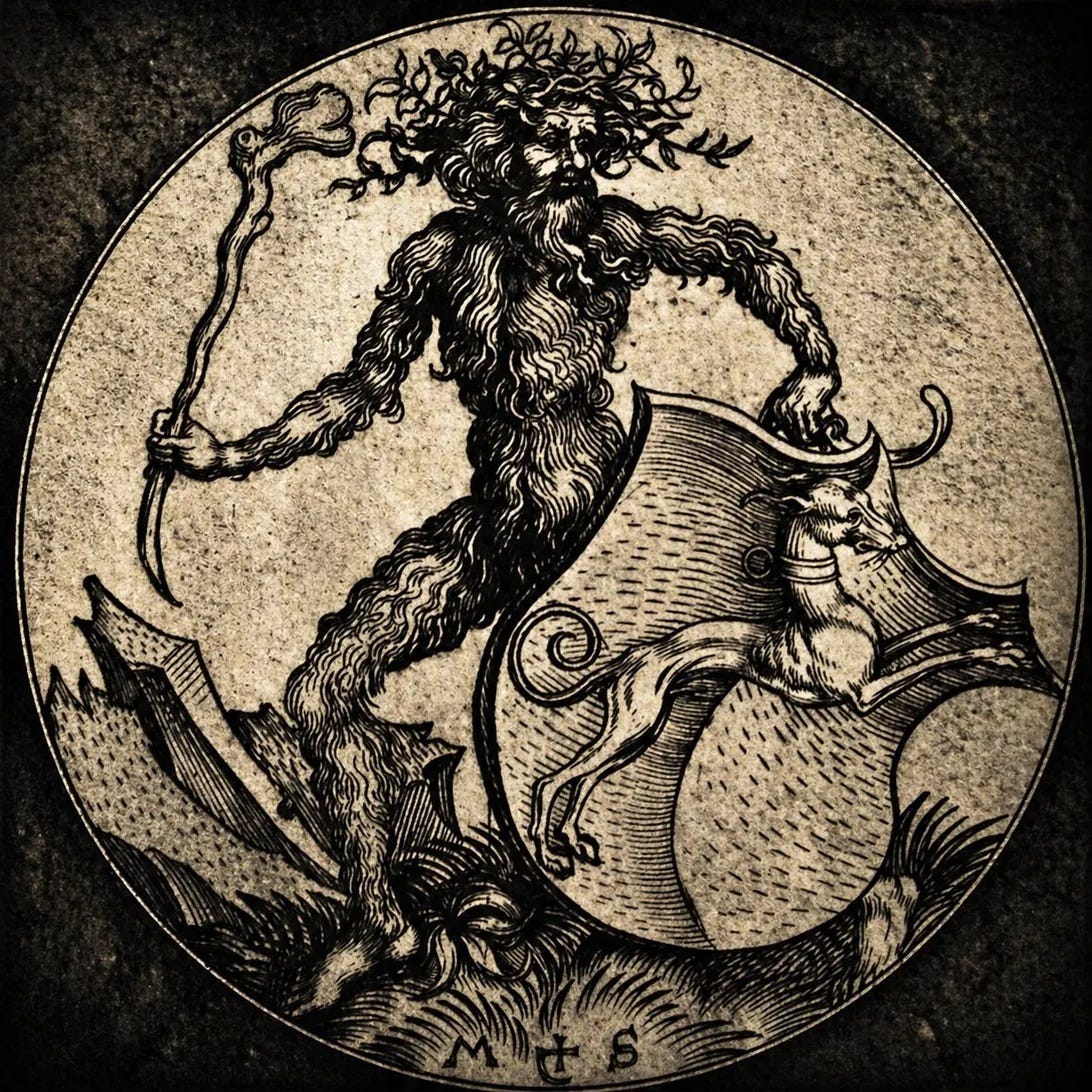
The first picture you saw in this article is a work by Schongauer, and the wild man here is a little different. He doesn’t wear the fierce expression of many of his cousins; instead, he is almost melancholic. His body is not reflexive but dynamic, full of energy, and covered in a great deal of hair. He carries a deadly weapon in the form of a club, proving even wild men can wield tools, and a heraldic shield signaling that he stands within the feudal order.
The image might seem unusual now, but for three centuries it raged across Europe like a wildfire. Cards, churches, tapestries, shields, manuscripts, these were the homes of wild men art, as much as the forests they were meant to inhabit.
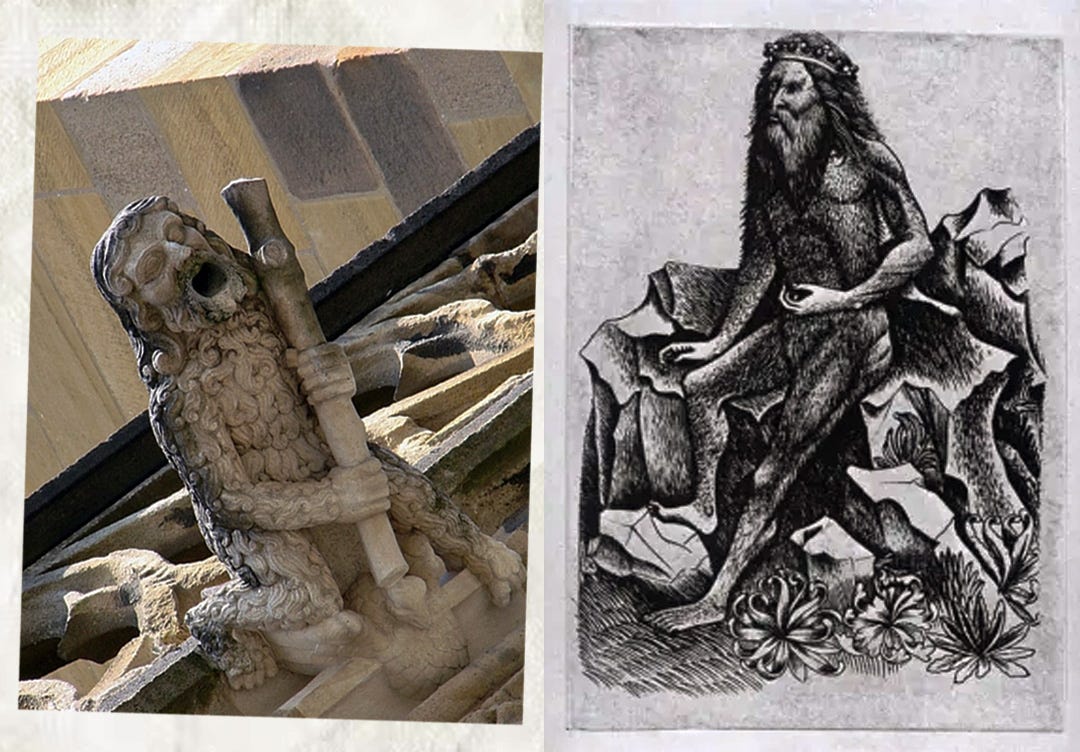
He was a constant presence in places like the Moulins Cathedral, protecting the building as a gargoyle, or, more mundanely, appearing as a playing card used for gambling and entertainment in taverns and courts.
In carnival, men from across the Alps would dress as him, wrapping themselves in savage cloaks of moss, pelts, and leaves, storming through villages in wild processions. The Krampus still echoes this animalistic ritual form today.
The Krampus is no accident. Of all the wild man’s modern descendants, he is the one who has stayed closest to the forest, and it is no coincidence that he is also the one who has survived. Because the wild man stands at several thresholds at once.
He represents a human side in deep contact with nature, yet wields a tool, even a crude one, that sets him apart from any animal. He stands between modernity and the Middle Ages. And he carries the legacy of the pagan satyrs, fauns, and other forest creatures into a Christian world.
The Shadow of the Civilized Man
A lit fire, strong walls all around, surrounded by civilization, the modern European man lived, and in that newfound comfort, he looked out at the brooding forest, being chopped down to make way for fields, villages, and pastures. And in those receding primeval woods, he saw a figure emerge.
The shadow of a past not as distant as we would imagine, one that resonated with raw, primal power, unashamed by the customs of society.
This creature represented the repressed energies that man had lost through urbanization. In art, there was an attempt to tame him aesthetically, but the impulse ran deeper than the conscious mind and was almost impossible to suppress.
The taming was hardest when it was most elegant, as in heraldry, where the wild man was locked in the steel cage of feudal hierarchies and made into a symbol of aristocratic power. This was perhaps the clearest attempt by the conscious side of Germanic culture to capture the creature and turn him from a dangerous, outside-of-society being into a useful symbol of civilization.
Still, almost like a real creature of the forest, he sometimes resisted the taming. One of the most brutal of these moments was the Bal des Ardents, the Ball of the Burning Men. The king of France, one of the most powerful figures in Europe, and five of his closest companions dressed as wild men for a court ball in Paris. Yet tragedy struck, almost like an omen of the danger of inviting powerful forces without fully understanding them.
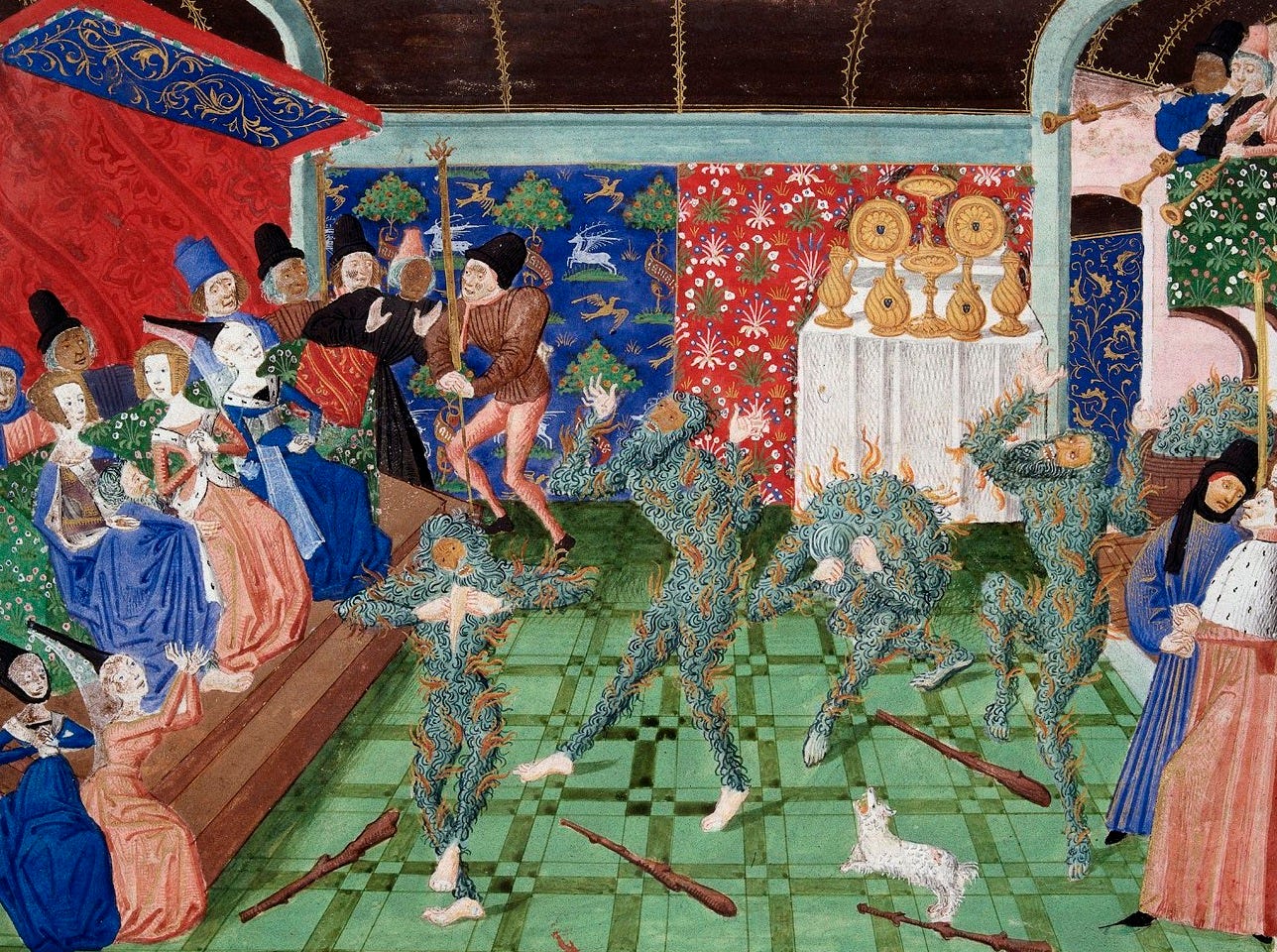
The king and his similarly attired companions all perished in flames, victims of a stray torch that turned the light-hearted feast into a tragedy. The fires ravaged them as their costumes ignited; one can imagine the desperate attempts to stop the flames, almost a cruel mockery of the planned dances. A night meant to celebrate life became an infernal danse macabre, the king dying in front of his wife.
Yet this was only a minor delay in the wild man’s career across European art. Barely a decade had passed before he was again a centerpiece. Because what he reflected was not only what man had left behind, but what he still wanted. Freedom from the confessional. Freedom from the contract. A body that did not need to be governed because it was already at home in itself. The medieval mind, hemmed in by ritual and rank, could look at this hairy figure and feel, for a held breath, that some part of the self had never signed any of those papers.
He is not gone. He went deeper into the forest
Archetypes are very hard to kill. Some might say impossible. They don’t live regular lives, paying taxes and commuting. They exist in a deeper layer beneath culture, geography, and time, but also stretching across them all, like a forest running through mountains, rivers, and valleys. Being out of the spotlight does not mean these figures have lost their strength; on the contrary, they may be gathering their power deeper in the forest of our collective unconscious.
In our time, most of us have traded the smell of ripening wheat in a warm harvest season for offices, service floors, and factory lines. Our forests are at their smallest. The wild side of our psyche may be forgotten, but it is not gone. It is not happy working 9-to-5, and it is ready to return with a nomadic strength our sedentary life is no longer built for.
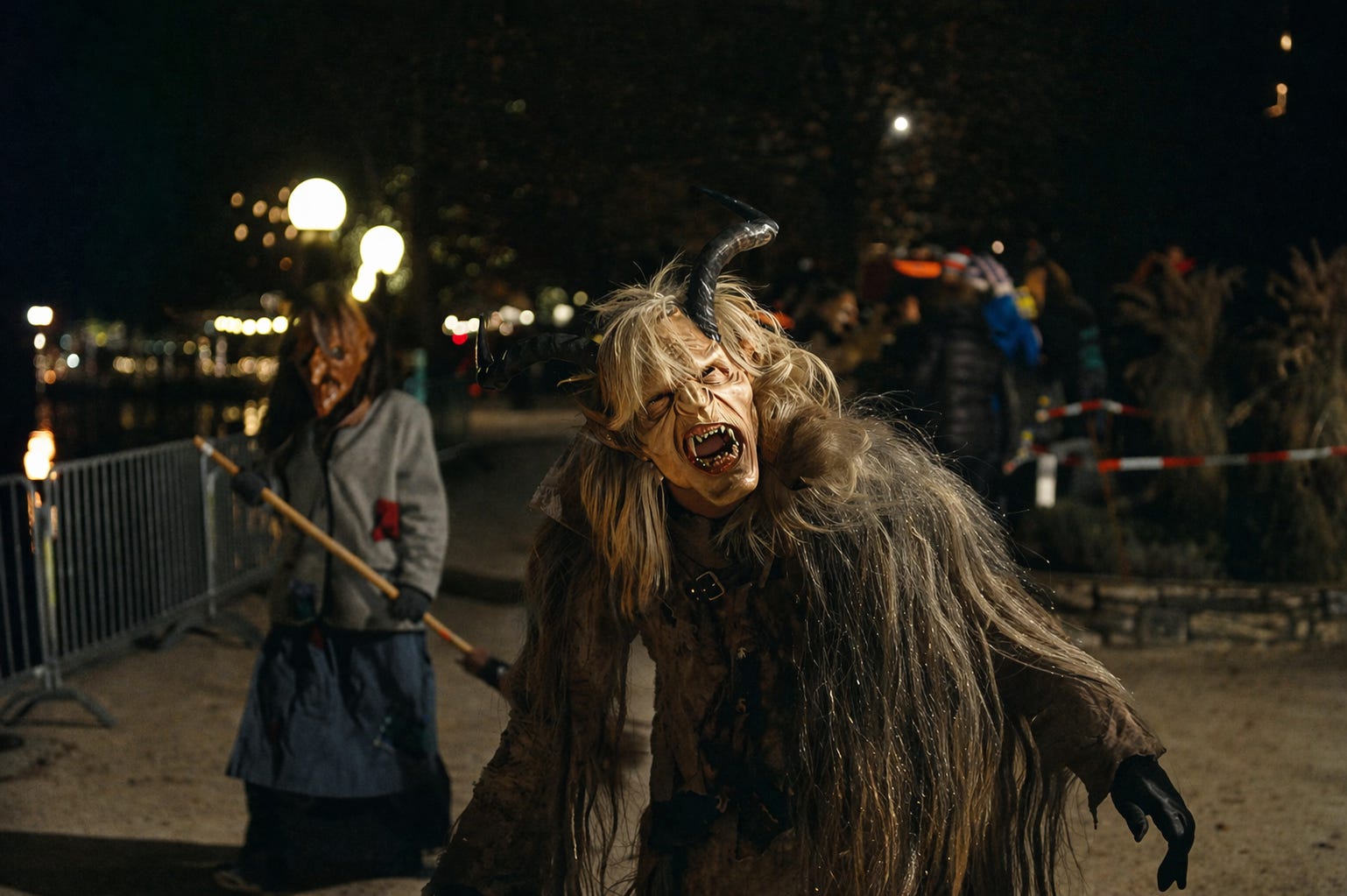
And live he does. In the Alpine region, he still rages as the Krampus, a figure who brings fright and terror to children and some adults alike. He is frightening, yes. But not only because of the fierceness in his countenance. He is frightening because he still lives somewhere beyond the holidays, deep in our inner forests, waiting to venture past the edges and invade our civilized life.
He carries terror, yes, but also a power to survive without any external help. An inner quality the Latin called indomitabilis: untamable. A quality so clear that not even kings could make the archetype bend to them without paying the ultimate price.