

For thousands of years, the people living on its shores across West Africa, Iberia, and the Americas looked at the horizon of an endless sea and saw the same thing.
The place where the land stops, the place where all maps end, and just beyond it, magic, wonders, and death.
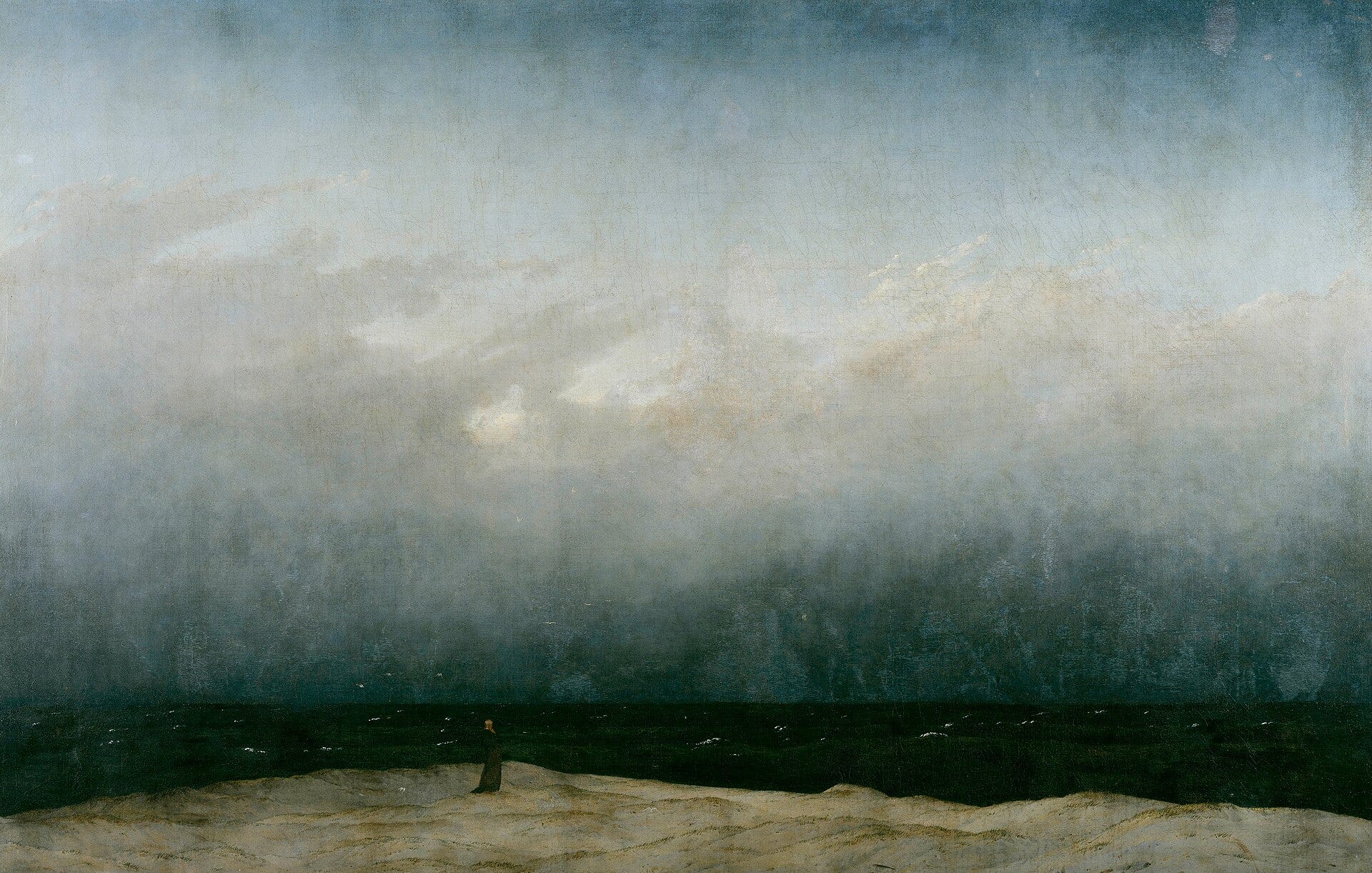
In 1810, Caspar David Friedrich exhibited Der Mönch am Meer (The Monk by the Sea), which captures what countless people have felt: a tiny figure, drowned by the boundless sea and sky.
When it was first shown, viewers did not know how to look at it. No ship, no tree, no story, just a man and an ocean that swallowed the canvas. Heinrich von Kleist said looking at it felt “as if your eyelids had been cut off.”
The painting unsettled them because they had already begun to forget what it was depicting.
The allure of a boundless, primordial, non-human, something. That needs no explanation or goal; it just exists.
The ocean has also been seen as a living force that can provide sustenance and wealth. In West Africa, among the Yoruba, the Atlantic was first the domain of Olokun, an Orisha who, according to legend, could grant great wealth and prosperity.
After the enslavement and with the development of African diaspora religions, Yemọja, or Yemanjá, came to represent the ocean and became one of the most venerated orishas on the American side of the Atlantic, while in Yoruba lands, it still retains its role as the Orisha and protector of many rivers.
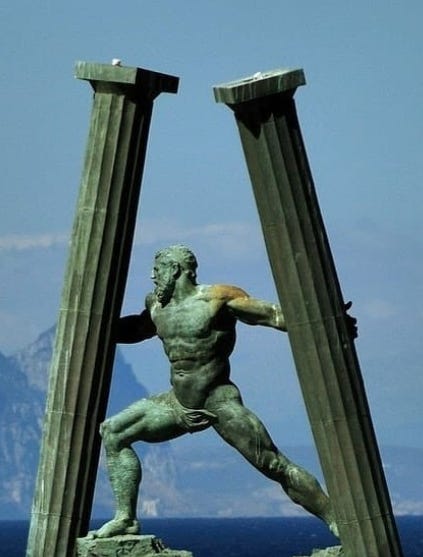
The ancient Greeks could imagine the genealogies of gods and the invisible particles that composed all matter. But what lay beyond the Pillars of Hercules, the boundary Heracles himself had set at the western edge of the world, they would not cross.
Beyond the pillars was Okeanos: not an ocean as we understand it, but a Titan. The great world-river that encircled all known land. To sail past Gibraltar was not to enter unfamiliar water. It was to leave the human world entirely and enter the body of something older than the gods themselves.
The warning carried across centuries in a single Latin phrase: non plus ultra. Nothing further beyond.
For the Norse, Njord ruled the sea as the patron of fishermen, bringing wealth from the waters. And uniquely among the gods, he was prophesied to survive Ragnarok, returning home to the wise Vanir when the rest of the pantheon fell. The ocean's god outlasts even the end of the world.
Read it forward, and the prophecy looks different; the next age would belong not to whoever ruled the soil, but to whoever could cross the water.
And crossed we did. First caravels in the late 1400s, then steamships raced across its surface in the 1800s, and now countless cargo ships move goods and resources in a day that the old world consumed in a decade.
We gained the world at the price of the horizon.
The Atlantic used to be the horizon, in its strongest sense, a boundary that we couldn’t cross and a limit to what we could claim. Beyond it lay the unknown, the unknowable, and the mythic.
Now the horizon has turned into a shipping lane, and the unknown lies in Wikipedia pages waiting to be filled.
And that takes us back to a monk watching the sea. A figure at the edge of the world.
There is a feeling we can all understand when our breathing goes quiet, and our chest softens as we watch the ocean on a still day. Something vast outside us meets something vast within, and for a moment, neither needs to be explained.
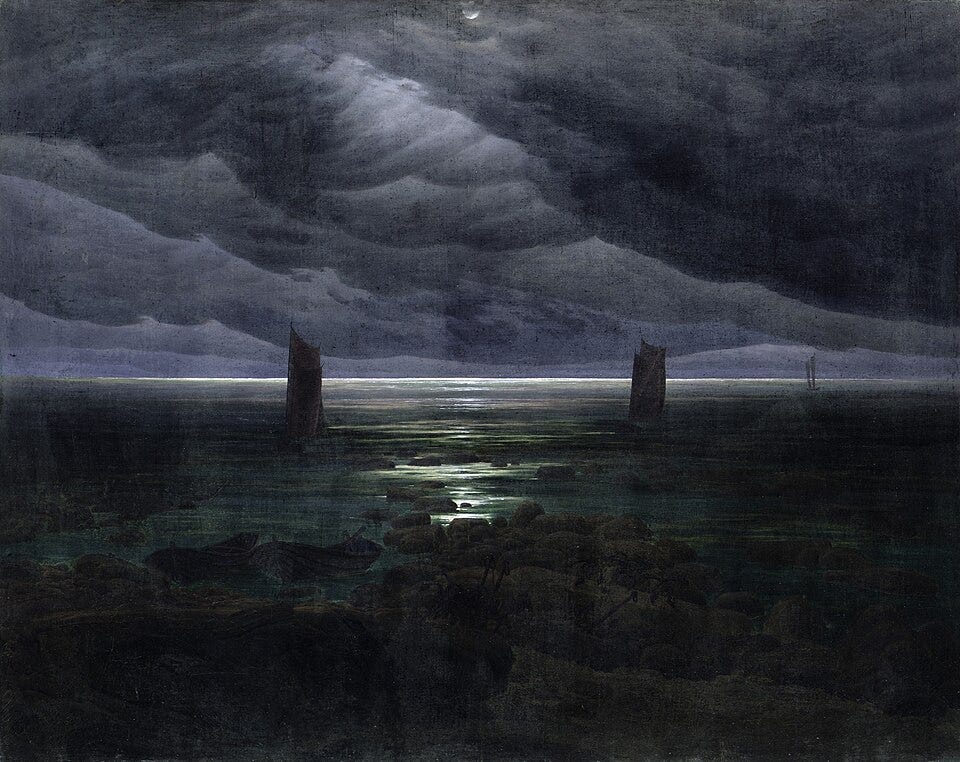
That feeling is what the ancients knew. It is what Friedrich painted. And it is what we have been slowly forgetting.
Mythic Echo is about remembering.
Every echo needs a voice to start it.
I enjoyed this, thank you! Your monk at the shore of the Ocean reminds me of Barry Cunliffe’s On the Ocean where he talks about Irish monks retreating to the most distant islands they could find for silence and prayer.
How far back do your maps go out of curiosity I'm well into meth and mythical and other mappings especially the litigation yeah if you could please text me back I'd appreciate it I'd like to know a little bit more about the way that I should I know a lot about it but I don't know mythical and some aspects I just know like the tides in the storms in the whirlpools and what's probably buried or dumped underneath the ocean