

Your throat feels dry. Your skin has almost turned to leather. For days, you have been tied up, held by chains between two blazing fires. A prisoner in a great hall. You come looking for hospitality, but the king was expecting an enemy. Your mind feels heavy and numb by now. You wonder what might be worse, the lack of food and drink, or not being able to move your shoulders and arms even an inch. For if you dare to move in any direction, the chain that holds your wrists together might stray closer to the fires. Being trapped is bad enough; there is no need to make the iron grow hotter. You hear soft little steps coming, and through the smoke, you see a child approaching. He has shaggy blonde hair and a colorful tunic, standing out against the black slate floor. His eyes show a little fear, but he softly smiles as he looks up. His hands slowly extend a horn full of mead. The drink is the only mercy you have been offered in days. The king’s hall is silent, except for the rustling of chains as you lean forward to drink.
The Hundred Faces
You and your companion walk through an ungrateful country. Darkness has fallen over the land, and the olive trees look like gnarled arms reaching towards the heavens. The dusty road has proven tiresome. Countless doors you have knocked on, and only cold rejections or silence have answered. Now, a little ahead, in a bend across the road, lies the humblest shack you have seen today. A small, tired, mudbrick house, with a few missing tiles on its roof. The faintest smile forms in your companion’s face. You approach and stop yourself mid-swing; your regular knock would be too hard on the rickety poplar door. A lighter tap is almost immediately answered. Out comes an elderly couple, their kind eyes and smiles greeting you even more than their words. They eagerly gesture for your companion and you to get inside, all but grabbing you and carrying you themselves. Their cramped house has an earthen floor where a lean goose looks at you puzzled. “Please, sit comfortably,” the old man says as he runs into the pantry and comes back with smoked pork and bread. And in turn, wine, olives, and cheese are served on a humble wooden tray. The wine never seems to end, to the amazement of the old couple. The old woman snatches up the goose, while her husband begs for forgiveness for having been such poor hosts. A divine hand stays the knife on the goose’s neck.
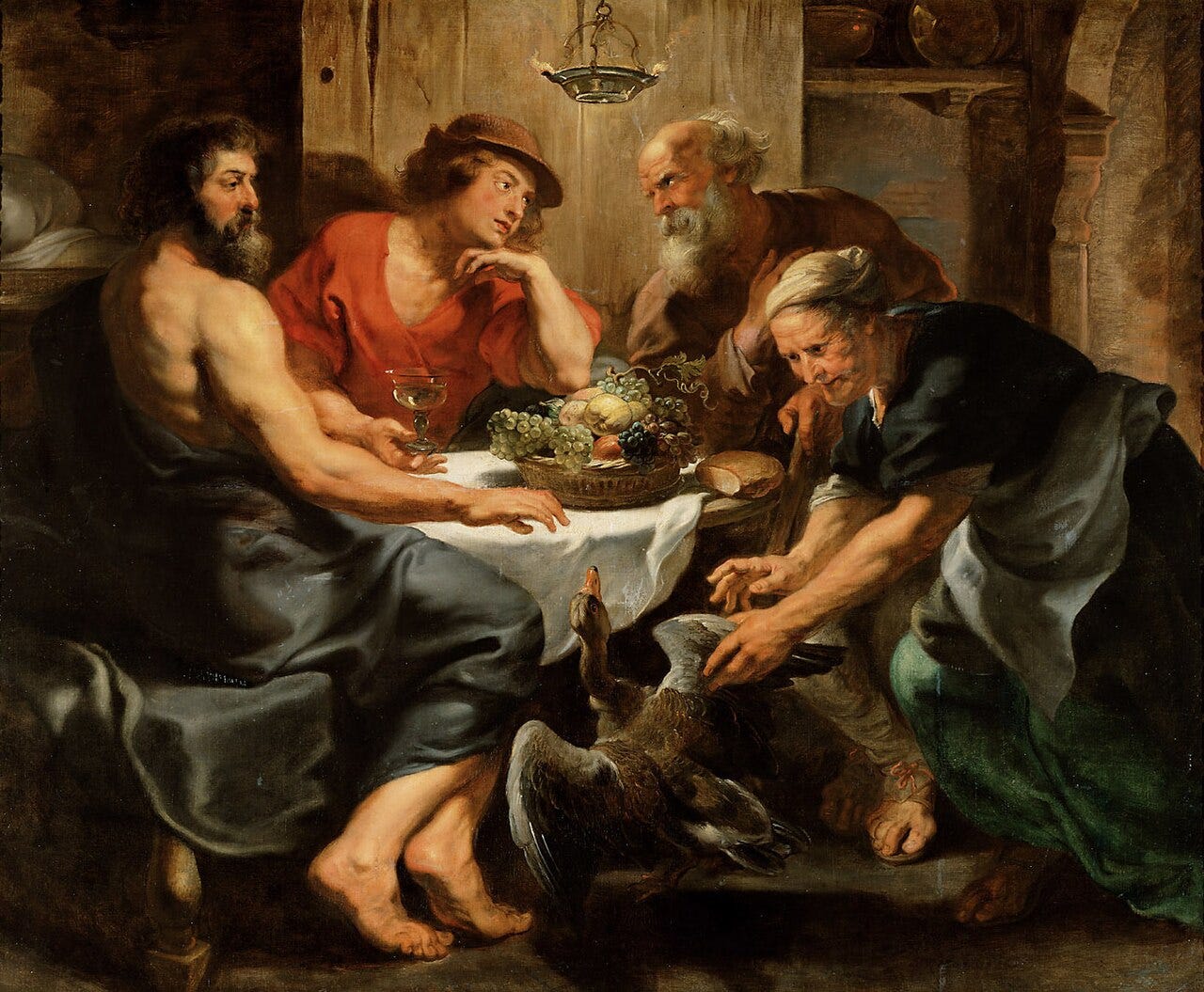
You and Hermes were no mere travelers. Enraged by the houses that had shut their doors, you drowned that whole ungrateful country under a single flood and spared only the one shack that had opened to you. You raised it into a golden-roofed temple, and granted the old couple the boon they asked: to die in the same hour, so neither would mourn the other. When the hour came, you made them two trees from a single root, leaning together.
The same test waits in every land. The traveler, the hermit, the beggar at the door.
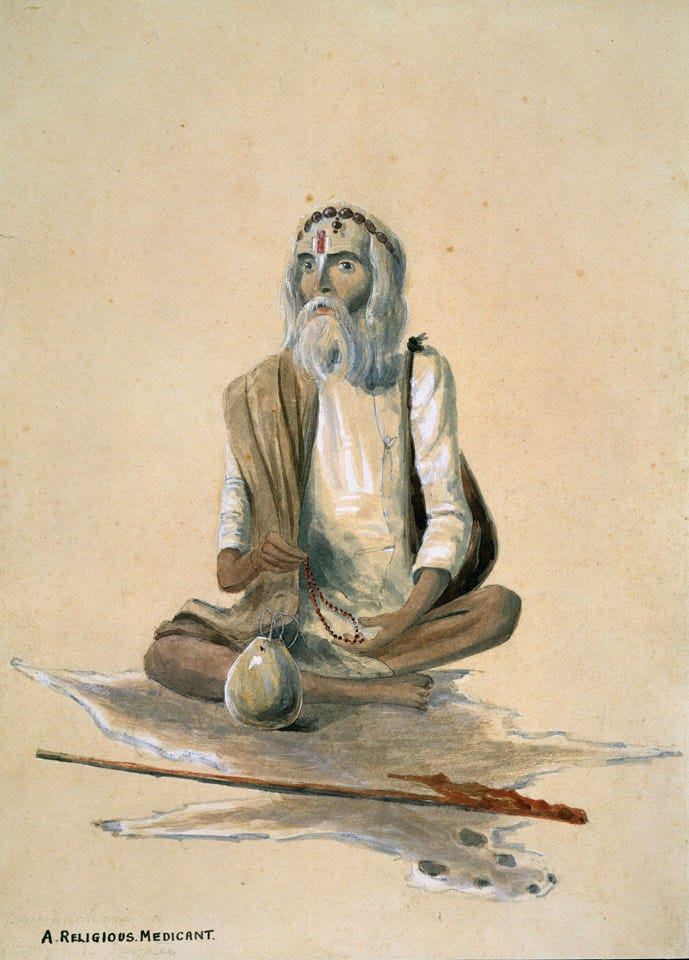
In India, both great gods test mortals in humble shapes. Vishnu comes to King Bali’s court as Vamana, a begging dwarf, asking only three paces of land and, granted them, strides across the entire cosmos in three steps.
Shiva wanders naked as Bhikshatana, the Supreme Mendicant, begging with a skull for a bowl, and the skull is one of the severed heads of Brahma, god of creation.
Old and New Testaments alike show the importance of tending the visitor, with the three at Mamre visiting the great patriarch Abraham.
Abraham, resting in the heat of the day, sees three strangers at the edge of his camp and runs to them, bowing to the ground, hurrying Sarah to her baking, killing his best calf for men he has never met. They are the Lord and his angels.
Finally, in Matthew 25, a radical turn occurs. The stranger might not just be god in disguise out to test them, but the test has already happened:
43 I was a stranger, and ye took me not in: naked, and ye clothed me not: sick, and in prison, and ye visited me not.
44 Then shall they also answer him, saying, Lord, when saw we thee an hungred, or athirst, or a stranger, or naked, or sick, or in prison, and did not minister unto thee?
45 Then shall he answer them, saying, Verily I say unto you, Inasmuch as ye did it not to one of the least of these, ye did it not to me.
Power Blinds
You have been shut out of the last village; their doors were closed on your face as the sun was bleeding over the horizon. Dust floats in the last reddish rays. And the tall, heavy doors of the prosperous village remain motionless. You start walking again, following the road deeper into the hinterlands. The path becomes narrower as the night darkens. The trees also become more populous, crowding the sides like peasants in a city, flocking to the streets to watch a king stroll. The cold is setting in, following the darkness closely. Then you smell it ahead, burning wood. A small fire, but a fire nonetheless! You pick up your pace, and soon enough, a rising column of smoke stretches black against the dark blue of the sky. A few more steps, echoing in the night. You see the village, far smaller, a few huts huddling together as if scared of the bigger world. Not standing tall and proud and demanding respect. Rather, almost kneeling, among the far taller trees. You approach the first door, and a dog barks, then a few more join in. You slowly knock on the greenish door, and for a moment, silence. Then it opens, the warmth rushes forward to meet you, and the smell of a stew too. The peasant looks at you, stops for a moment, smiles, and gestures for you to enter, while the rest of the family hurries to greet you. It is always this house. A thousand doors, and you read them now before you knock: the tall ones stay shut, the bright halls bar themselves, and only the houses with nothing left to guard ever swing open. You used to think it was kindness. It is not kindness. It is that a man with a throne to protect cannot afford to see you…
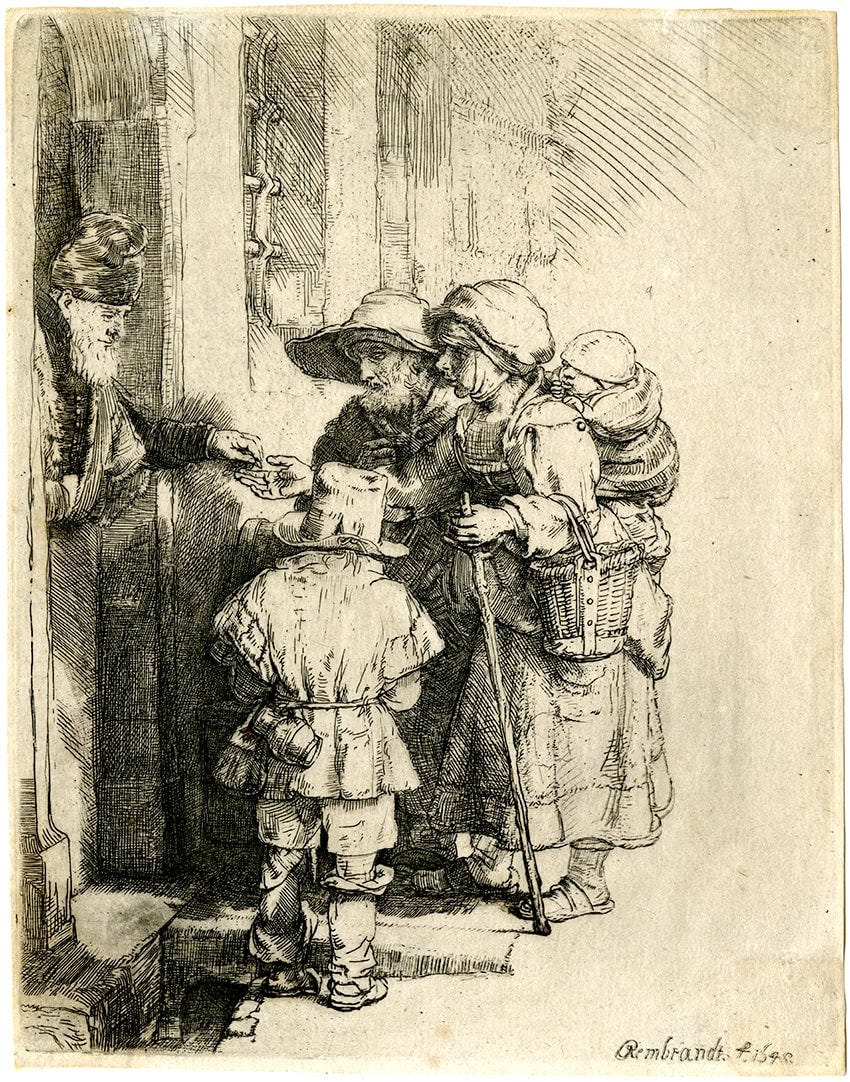
Wealth and power have a way of needing walls, and not only the stone kind. A man with much to lose learns to keep the world at arm’s length, to bar the gate and weigh every stranger before letting him in. But the god at the door asks only to be let in, and a man who has spent his life learning to keep things out has forgotten how to open. The same walls that guard him from the thief guard him from the divine.
The powerful eye learns to read status in a glance: the cut of the cloak, the weight of the rings, the way a man holds his shoulders. It sorts the room before a word is spoken. And the god comes wearing nothing; it can read no rings, no cloak, no bearing, only rags. So the eye does what it was trained to do. It passes over him. And there is no more dangerous thing in the mortal world than a being of absolute power but no apparent status.
The Price of Walls
You sit down in your sofa chair, a new season just dropped, and a burrito bowl has been delivered. Nothing could be better on a Friday night. You check that the drinks and condiments are perfect as the ta-dum plays on the TV. Then you hear it. The faintest buzzing sound to your right. A phone is vibrating. Your phone. You sigh so hard it’s almost a hiss. You pick up the humming little distraction, and on its screen, a sentence “Are you up? Can we talk?” You look at the screen for one more moment before you slowly turn it off. You sit down again and unpause the TV. On the screen, an old man chained between two fires lies in front of you. The prisoner looks straight at you with one gleaming eye.
Beside you, the phone buzzes once more against the cushion. You do not look down.
"A man with a throne to protect cannot afford to see you" -- the eye that sorts by cloak and rings isn't broken, it's doing exactly the job the ego trained it to do, which is why it works so well on kings and so poorly on gods wearing rags. Doesn't need to be a literal Vishnu at the door for the pattern to hold, either. If it's really one current showing up in both the beggar and the host, failing to recognize the stranger is just failing to recognize your own current in a body.