

“I saw something move.” Haunting words to hear in the middle of nowhere, with only one other person beside you, during a moonless night. Words that have been uttered countless times by people during the dark hours. Sometimes it was a friendly visitor, coming to see if some help was needed, sometimes it was a small animal as afraid as we were.
Other times, those could have been the last words that people said, as enemies or predators fell upon them.
But so many times, the shadows that moved vanished as soon as they were seen. The thing that caused them was called a ghost, a goblin, a man-eating beast of legend.
In myriad tongues, by innumerable names, so many now long-forgotten.
And yet they share a single nature. They are the monsters — the non-human, the malevolent — the others who carry with them our own capacity for evil, cruelty, and cunning.
The Minotaur: A cosmic punishment
You are alone in a labyrinth; the dim light of your torch barely shows the moss-covered Cretan limestone walls. They surround you; they feel as if they are pressing on you, slowly crushing you. Then you stop, your heart sinking, not because you saw something or heard something. You smelled it. The unmistakable smell of a bull, and something else, blood.
The Minotaur was a being born of the transgression of divine law. Minos received a white bull from Poseidon, after asking for it as a show of the god’s favor. Then, upon receiving the creature, he marveled at its beauty and decided to keep it rather than sacrifice it. The universe was moral, and transgressing its law meant suffering. Poseidon made Pasiphae, wife of Minos, fall in love with the bull, and from her, the Minotaur was born. A half-human, half-bull beast, a living example of the hubris of a tyrant.
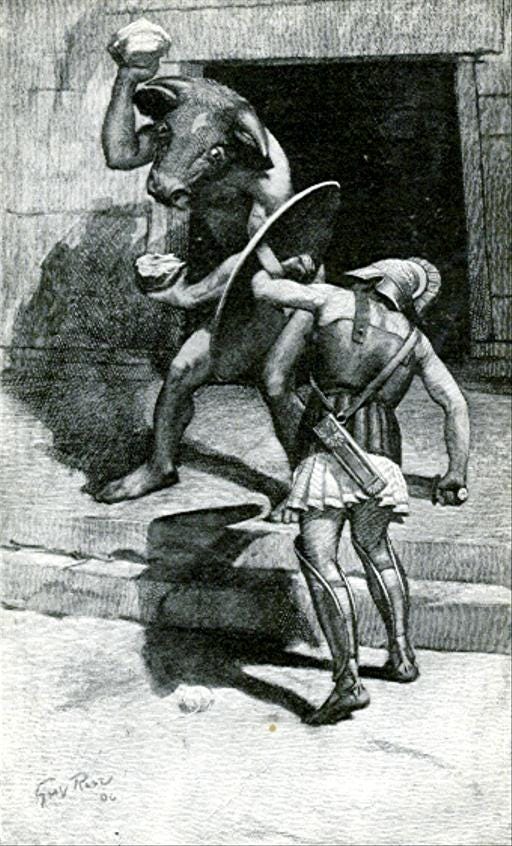
This being was beyond the realm of empathy and understanding, relegated to a geometrical prison and forgotten by most; even today, you won’t hear anyone say, “I’m feeling like such a Minotaur today.”
The Minotaur could not be us. He had no human face, and his origin was cosmic, two layers of distance between us and the monstrous other.
The Manticore, the Medieval Man-eater
You sit down on a cold bench in the scriptorium of your monastery, close to the window to catch the last lights of the afternoon, you open up a manuscript, and you shudder. There lies a being of pure evil, a monstrous creature far from the grace of God. You pick your goose feather quill and begin your copying by drawing its cursed, smiling face.
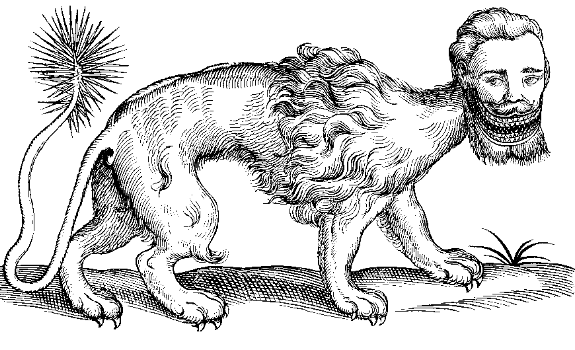
Medieval bestiaries were not simple descriptive encyclopedias. They were moral, they had the imprinted soul of Christian Europe as much as the ink upon the parchment.
The manticore had a special place. Unlike the dragon, who could sometimes be reasoned with and, in a few tales, was even a force for good, the manticore, whose Persian name means man-eater, was pure cruelty, voracious hunger, all of it housed in a mocking human face.
You did not notice its lion’s body first, or even the spike tail, but the three-rowed smile in a face that could otherwise pass for a person.
Medieval times brought the monsters closer, but they are still the inhabitants of faraway, mysterious lands; the monstrous other lies in bestiaries copied from older texts and adapted by the medieval imagination into symbols of the danger that comes from straying from the kingdom and the church.
Dracula, the Courteous Murderer
You follow Dr. Van Helsing across a soaked, bleak Victorian London street, the smell of smoke and horses still lingering in the foggy metropolis. He turns around when he notices you are shaking, from a mix of the chilly weather and the prospect of facing an ancient evil at night. He clasps your shoulders, calls you a good and true friend, and says:
"We have on our side power of combination — a power denied to the vampire kind; we have sources of science; we are free to act and think; and the hours of the day and the night are ours equally. … We have self-devotion in a cause, and an end to achieve which is not a selfish one."
Dracula by Bram Stoker, Chapter XVIII
The monster is now closest. He has invaded your city, he masquerades as a regular, law-abiding citizen, and he preys on the blood of your people at will. He steals your fate and can condemn you to an eternity as his servant, as a being denied the gates of Heaven. From dark and distant lands, he came, and to conquer is his goal.
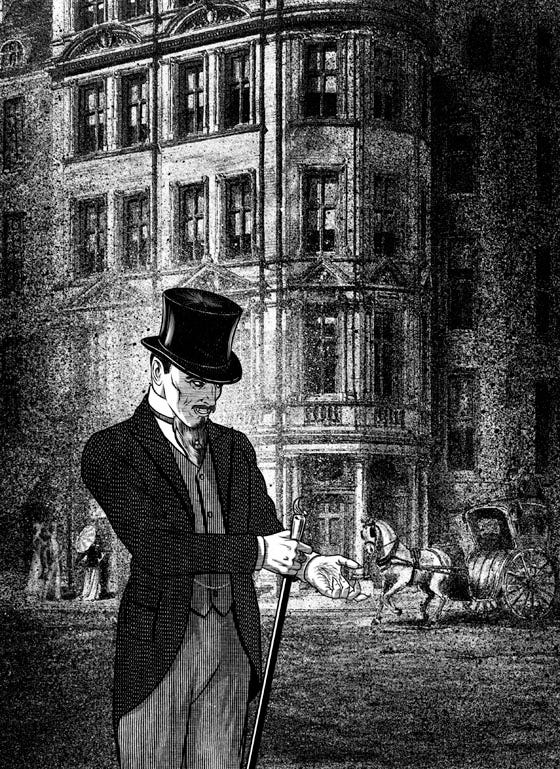
The Victorian fears of the outsider were made crystal clear with Dracula, a being of ancient evil, who mastered dark and mysterious arts, even attending a Magic School presided over by the Devil himself. And the heroes oppose him, with the full power of science, backed by a strong devotion to doing God’s work and the love they hold for each other.
They are pure, strong in their unity, and clear in their goal; even in the grim dilemma they found themselves in, they have reasons for joy and camaraderie. Dracula, even though it’s a Gothic tale, is also quite heroic and hopeful. Even though British Victorian society was far from perfect, they still held a strong faith in God on the one hand and an optimistic hope for science on the other. Van Helsing even takes the time to bring up superstitions, too, into the fight:
“All we have to go upon are traditions and superstitions… Yet must we be satisfied… because, after all, these things—tradition and superstition—are everything
Dracula by Bram Stoker, Chapter XVIII
It is hard to imagine a time when protagonists could wield such complete powers, leaving nothing outside the realm of the possible. Their initial skepticism quickly breaks down after witnessing the horrors, and they bring the full range of possibilities to bear in their fight against evil.
Zombies, Infected, and other mindless monsters
You crouch in a boarded-up, lightless, abandoned second floor of a store. You just finished eating a cold can of peas. With renewed strength, you crawl towards one of the less closed-up windows to peek outside, even for a second. You see a vast horde on a main street, slowly shuffling away, a current like one from a river of rotting former humans. You despair as you miss the comforts of your previous life and dread turning into another contagious member of that inhuman march.
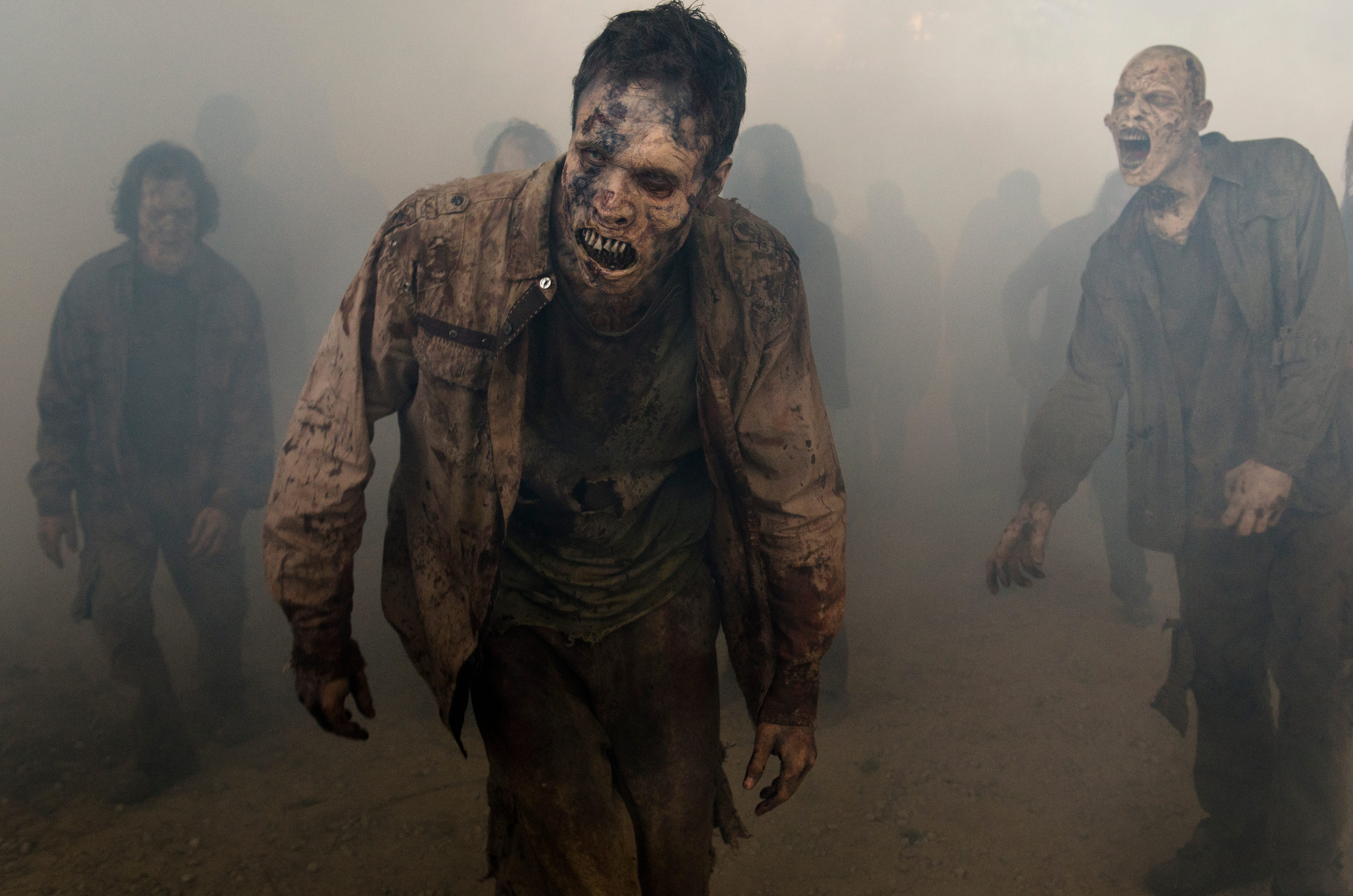
The zombie, or infected, is a former human, a victim of a disease, be it a virus, a bacterium, or even a fungus. It has lost its individuality and its power of reason. The very things that our modern world calls the truest expressions of being human.
Even if the cause is materialistic, close, and grounded, no longer haunted by the paranormal, we find the most abject terror in conjuring new versions of the diseases that plague our world
The common thread of darkness
The monsters we once feared have been getting closer. From a being trapped in a labyrinthine world, a victim of cosmic retribution, to a fantastic creature in an exotic land, to finally the supernatural invader, to the zombie, a former human who lost its humanity to a plausible natural cause. The monsters no longer must haunt us with a supernatural cause and a distant origin; they are now our neighbors, friends, and family turned into mindless beasts.
The stakes have also been changing, becoming deeper, more personal. Once a Greek hero facing the Minotaur would only have to worry about being gored by the beast. A medieval knight exploring the Manticore’s realm would be devoured whole, his clothes and equipment gone with him. Dracula’s victims' souls were at stake and an eternity in hellish existence. Finally, the zombies take away our whole self, reducing us to a mockery of our life, with only the worst possible parts remaining.
Not only have monsters been pushing on, approaching us, but they have also raised the bet over and over.
Why we still need the monstrous other
We wouldn’t be human without monsters. We need to point into the darkness and call out the beings who are the opposite of us. And we need to recognize that we can become just like them if circumstances press us hard enough. The monster is both the outside that makes the inside legible and the warning that what is inside might be outside-shaped if we let it.
Every healthy culture has known this and built specific practices to keep the conversation alive.
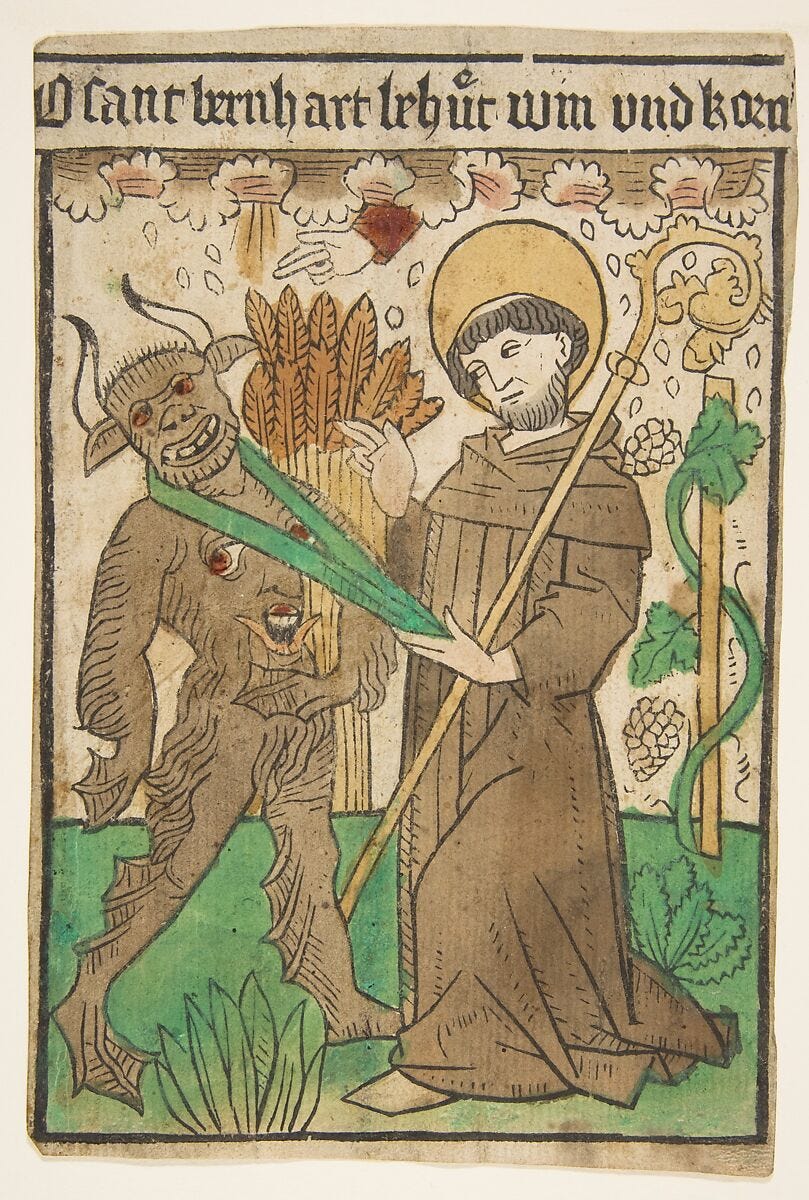
In the medieval European village, the Devil had a name, and his servants had specific shapes. The Black Mass could only be officiated by a fallen Catholic priest; even the inverted ritual required the form of the original. And the village did not sit idly while darkness encroached: processions wound through the streets, bells rang from the steeple, prayers warded off what walked at the edge of the firelight. They had not banished evil. They had given evil a calendar, and evil that has a calendar can be met.
In Algonquian tradition, the Wendigo did the same work in a different register. When someone hoarded food while his community starved, or took too much for himself during the long winter, that man could be named Wendigo. The naming was a moral diagnosis dressed as a story, the community’s way of pointing at a real failure of a person, and reminding the rest of the dangers that can cause them to err.
What both traditions understood and what we have forgotten is that naming the monster is the act that contains it. The villager who can name the Devil can refuse him. The community that can name the Wendigo can intervene. The hero who can name the Sirens can lash himself to the mast. The monster gives the tragedy, the moral failure, the worst possible part of being human a clear name. And the unnamed monster eats you in your sleep, it grows in the unspoken and unchecked, until it has devoured everything.
For thousands of years, this was the work the monstrous other did for us. And now, over the last century, we have decided that we don’t need that anymore.
What Hunts Us Now
Have you felt a creeping dread at moments that should be full of respite? Is anxiety haunting you worse than the Devil haunting a lonely frontier’s pilgrim cottage? A feeling of restlessness worse than a Celtic farmer hated by the fae?
That’s the price we have paid for losing sight of the monsters.
We become incapable of naming evil. Of giving it shapes we could understand and fight. The result is a life in constant fear of something that’s unnamed, unaddressed, and certainly not faced together.
The monsters are still out there; we just made them nameless and, in a way, far more dangerous.
They have become the exclusive domain of horror movies, video games, series, tabletop roleplaying games, and other media, because conscious culture refuses to name them aloud.
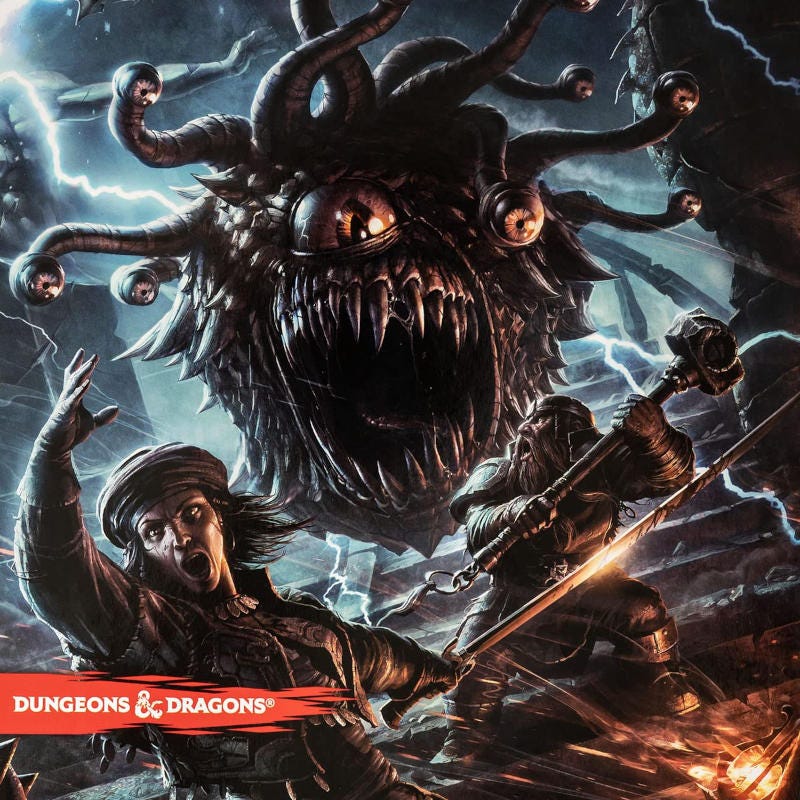
There is yet another catch: not naming and pointing has caused us to let the monsters become faceless haunts; that’s one of the great tragedies.
There is a solution, not to go back to the olden times, but to name the fears, evils, and shadows that are part of our collective unconscious. To bring them to the light, and give them a shape that serves us again. It’s not an easy fix, nor a fast and clear solution, but that’s also part of why it’s so necessary in a world obsessed with the quick and simple.
This is the work the old cultures did, and we have stopped doing it. This is the work that has to be done again. There is no other path back to a world we can stand inside of.
And maybe then, we could find that lost part of ourselves again, and see how the shadows that haunted us are not so terrible once we can name them.
It's wonderful, thank you. What names can we give them?
Fantastic read, I loved it!