

Trees are whispering in the wind. They sing songs in a language older than you, older than your kingdom, older than your people. The singing gets harder as the night begins to slowly creep over the horizon. The red dusk feels like a wound inflicted on the Sun, and it’s slowly bleeding out. You can smell the damp soil and myriad resins being carried away from the woods, almost like invisible tendrils stretching in every direction.
Forests mean danger. Forests at night are the stuff that terror is made of. One day, your uncle went looking for a goat in the forest and was never seen again. Your village has stories about bandits, poachers, and wild men living deep in the woodlands.
And those are the most human of dangers you could meet in a clearing. Then there are the creatures from the other side, beings who lurk far away from people’s eyes, whose nests and lairs are in the thickest parts of the wilderness.
They do not forgive a trespass.
The forest is not friendly. It was never meant to be. It is where the story begins, or where the story visits, almost never where the story ends.
Endings are the domain of civilization, of great banquets, castles, and towns alive with celebration and joy. Not the whispering of trees in the night.
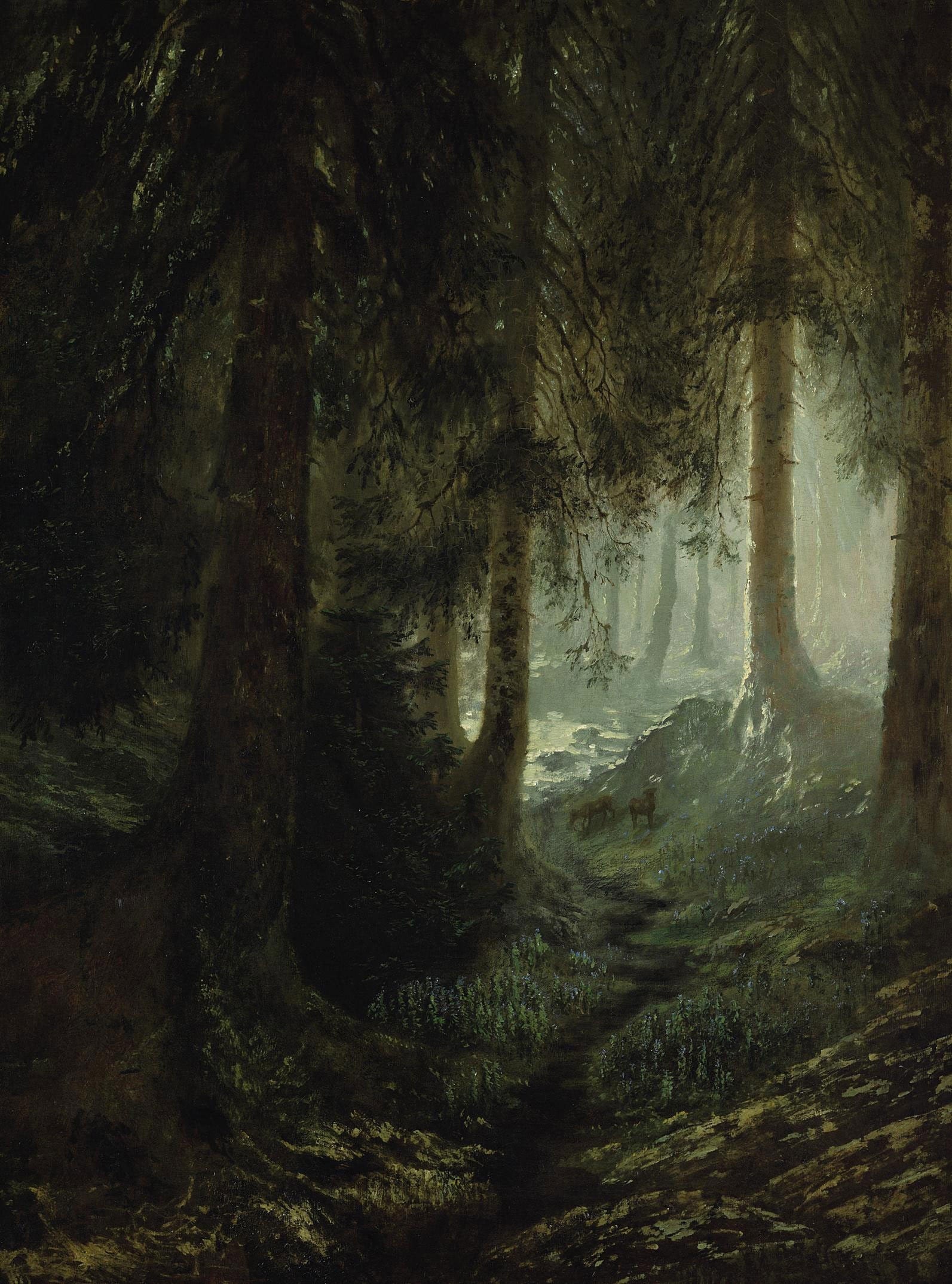
Where the Old Stories Begin
Villages have walls, fire, and people. All of this together means safety, comfort, and a sense of commonness. In stark contrast, the forest lacks such comforts, and they are quite lonely. Their existence as wild places, where nature rules and humans have to navigate with care, makes them rich in potential for Myth and stories, both of bravery and of utter despair.
There is a woven pattern across Europe, where ancient forests become such an integral part of stories that they pretty much are characters in themselves.
Hansel and Gretel would be a very different tale if it took place on a warm tropical beach instead of in the haunting depths of the Germanic Dark Forest. And that’s because at their core, the woodlands are places where nature shows its raw power. The green tapestry woven by thousands of living beings depicts non-human architecture, coexistence, and communal life.

And yet the stories the people of those forests told themselves were not about coexistence. They were not even about beauty. They were about the wood as the place a human being went when something terrible was about to happen.
Hansel and Gretel are taken into it by their own father. Little Red Riding Hood walks into it and meets the wolf, who has eaten her grandmother. Vasilisa is sent into it at night, alone, to fetch fire from a witch with iron teeth. Snow White flees into it with the huntsman’s mercy in her ears. Sleeping Beauty’s castle waits inside it, behind a hundred years of thorns. The hero of every Russian tale rides three days into the temnyi les, the dark wood, before anything worth telling happens. The knight of the French romances rides into the forêt sauvage and loses his mind.
These are not the same story. They were told by different people in different centuries to different ends. The Russian peasant did not know the German storyteller. The German storyteller did not know the French troubadour. None of them sat down to coordinate a tradition.
And yet they all begin in the same place. The edge of the wood.
This is beyond any coincidence; it is a clear hint of a deeper layer of our collective unconscious.
Why? Why do the oldest stories of so many different peoples agree on this single point that the wood is where the story begins, never where it ends? Why is it always the trees? Why never the marketplace, never the hearth, never the king’s hall, except as the place the hero finally returns to?
Because the storytellers knew something. Something modern life has tried very hard to forget. The forest is not an obstacle; the forest allows the story to grow, branch out, and flourish.
The Descent Before the Ascent
Spiritual traditions went deeper into the woods.
Buddha begins his journey in a royal palace, in one of the most prosperous civilizations on earth. His story as a prince starts at the most radically opposed place from the forest, yet it is in the forest that he achieves illumination, under the Bodhi tree. The mundane offers protection but brings no answers to the deepest human questions; the forest offers the opposite: no safety, but a true encounter with the deepest layers of ourselves.
Wilderness, from the Hebrew Midbar (מִדְבָּר), sometimes translated as desert in the Bible, is an open, savage land where civilization no longer holds sway; though topographically different from European forests, it accomplishes the same. It strips us of the usual tools and distractions of our daily life and forces us to confront a darker part of our world.
After his baptism in the Jordan, Jesus is driven by the Spirit into the wilderness. The Greek verb is ekballei, the same word used for casting out demons. He does not choose to go. He is thrown.
He fasts for forty days. The number is biblical typology: Moses fasted for forty days on Sinai before receiving the Law; the Israelites wandered for forty years in the same wilderness; Elijah walked for forty days to Horeb. To enter the Midbar for forty days is to enter the place where Israel’s identity has been forged again and again, by hunger, by terror, by the voice that speaks out of the dryness.
And there, the devil meets him.
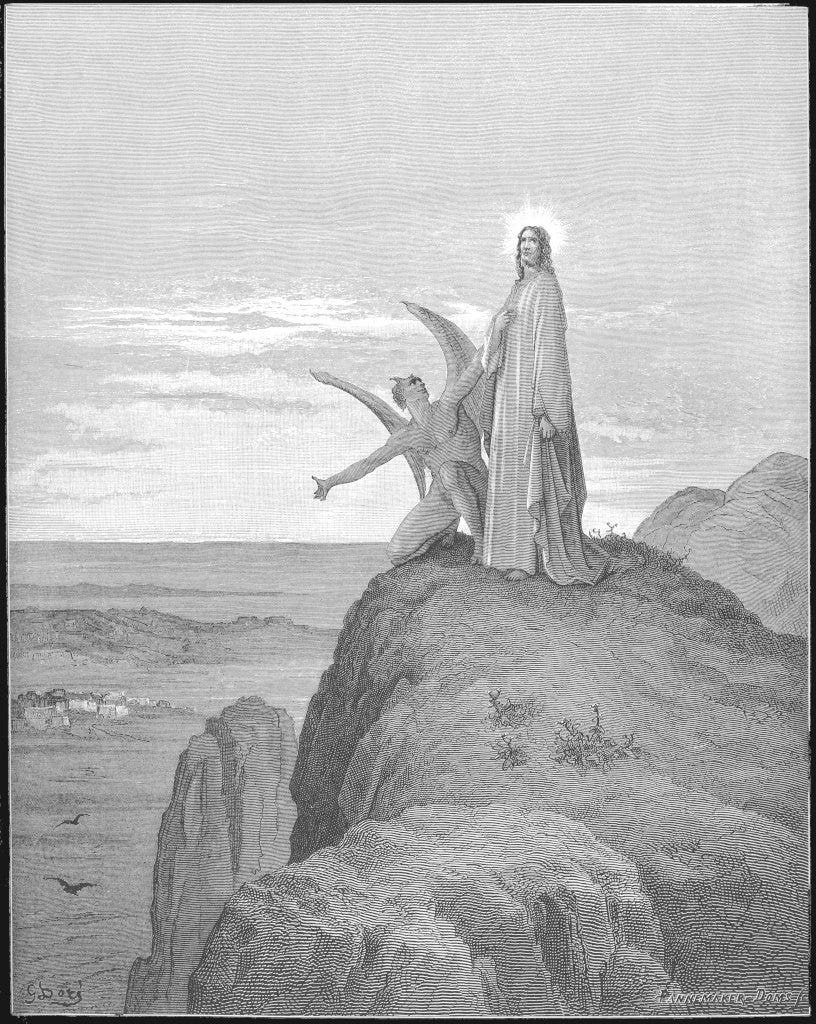
Three temptations. If you are the Son of God, command these stones to become bread. Jesus refuses. Throw yourself from the pinnacle of the Temple the angels will catch you. Jesus refuses. I will give you all the kingdoms of the world if you will fall down and worship me. Jesus refuses.
Each refusal answers a specific seduction. The body turns the dead world into food. The spectacle makes God prove himself by saving you publicly. The power to accept dominion over the world by accepting its prince as your god. These are the three doors out of the wilderness that look like exits, and are not.
The devil leaves him. The angels come and minister to him. He returns, and his ministry begins.
The angels came. The devil left. He returned. Changed.
Dante Alighieri also begins his journey in the forest. He is midway through life. The straight way is lost. The wood is his despair. What he discovers there is that the route to heaven runs through hell.
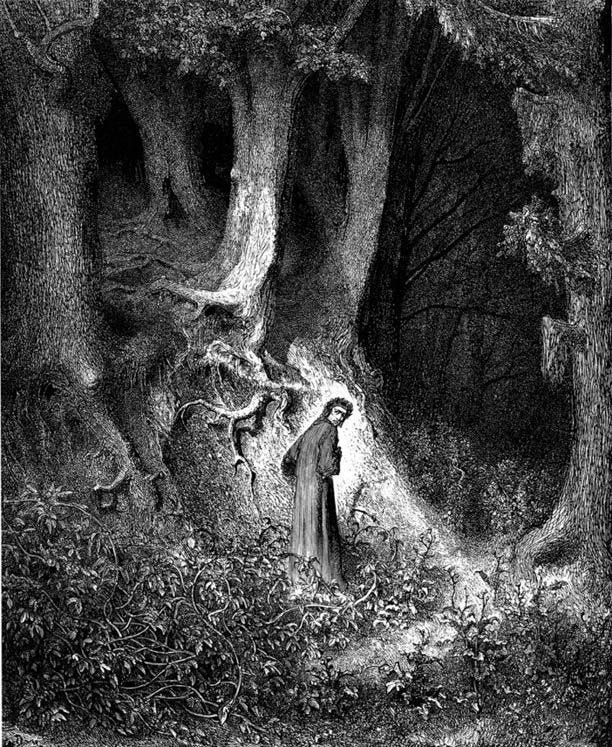
Nel mezzo del cammin di nostra vita mi ritrovai per una selva oscura, ché la diritta via era smarrita.
Midway in the journey of our life, I found myself in a dark wood, for the straight way was lost.
Only from this place can he approach the gates of hell. The Comedy walks down before it walks up Inferno, then Purgatorio, then Paradiso. Three books coming together to form one clear metaphysical direction for the human soul. And the forest is the initiatory space that allows the soul to begin the wonder-filled journey.
The Wood Was Always Within
Darkness ahead, rotting trunks side by side with mighty trees reaching for the heavens. Since the first stories, the forest has been the heart of all that the waking mind can barely look at.
We filled it with beings, beasts, and dangers, some real, some that had been moving through human dreams long before they had names.
The forest is not a representation of the unconscious. The forest is the unconscious, externalized, walked, lived in for ten thousand years before we put it inside our skulls and called it psychology.
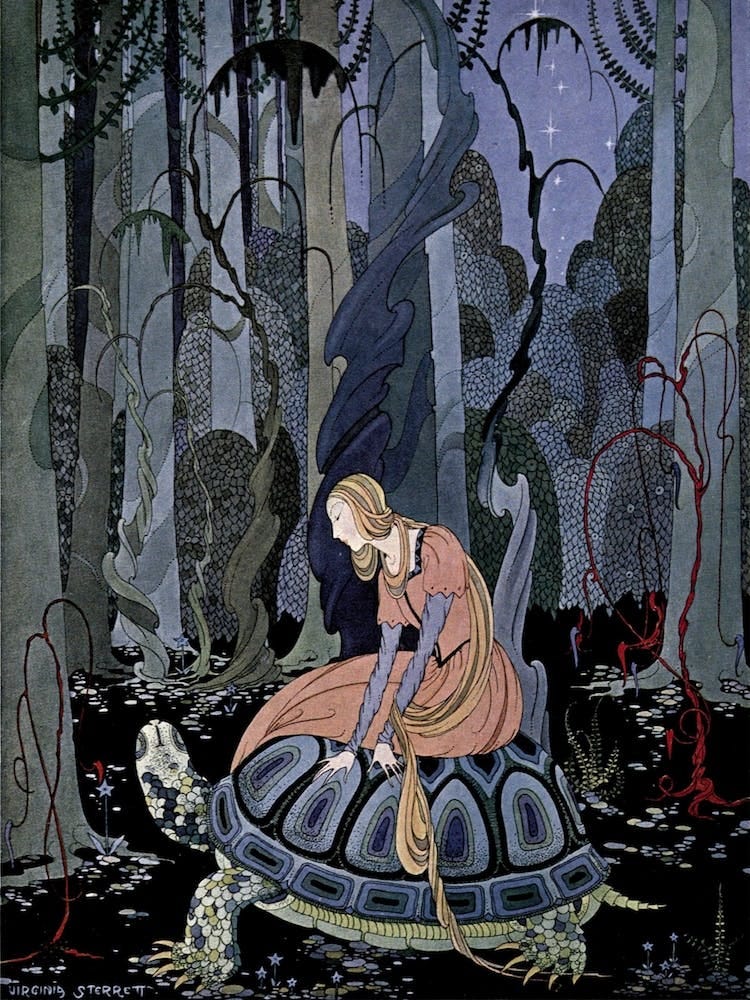
We have shrunk the forests. We have pushed them farther and farther from our cities. We have cleared them, paved over them, fenced them in, and reduced them to managed parks at the edges of towns where children visit on weekend hikes. We have, by every external measure, won the long war between the village and the wood.
But the forest was never only the trees.
The forest that Hansel and Gretel were led into by their own parents. The forest Vasilisa was sent into at night to fetch fire from a witch. The forest Dante woke up inside, midway through his life, with no map and no path, that forest never left us. It went where it had always also been. It went underground. Into the dream. Into the strange grief of a life that has every external good and is still not at peace.
It still lies deep within. Waiting for the next story to begin.
This was a beautiful read, thank you! Loved the images as well 🙌🏼